
JBhunt UX research Ai agents
AI and the creation of AI agents are becoming critical tools for streamlining the UX research and design process. I created two agents for the J.B. Hunt UX team to use during and after the research phase to help navigate and organize the J.B. Hunt research repository. These agents were designed to function as personal assistants for the UX research team. Their implementation helped spark the creation of an additional UX content AI agent and encouraged broader brainstorming around how AI can be further integrated across functional teams into everyday workflows to improve efficiency while saving time
and money.

The Process
My Role
UX Designer / UX Research Intern
Collaboration
I collaborated closely with:
-
Meghan Dryzga (Director of UX)
-
John Coker (UX Researcher)
-
Seenu Jacob (Principal Product Designer)
-
Dillon Word (Product Owner II)
This project began with a simple question:
How can AI agents support and accelerate the UX research team’s workflow?
UX Researcher John Coker and I were given this exploratory project, which quickly sparked a broader curiosity about how AI could be integrated across the UX research and design process at J.B. Hunt. We began by evaluating how much effort was required to structure the agent’s knowledge source in order to achieve accurate and reliable results.

When we first began this project, we had very little knowledge of AI agents. I started by researching and watching recordings of previous internal meetings where teams discussed or demonstrated agent creation.
As I learned, I began creating process diagrams and charts in real time. This served two purposes:
-
They made check-ins with Researcher John Coker more productive by allowing me to clearly communicate progress and decisions.
-
They helped me document and reflect on my own learning, making it easier to see the bigger picture as the project evolved.
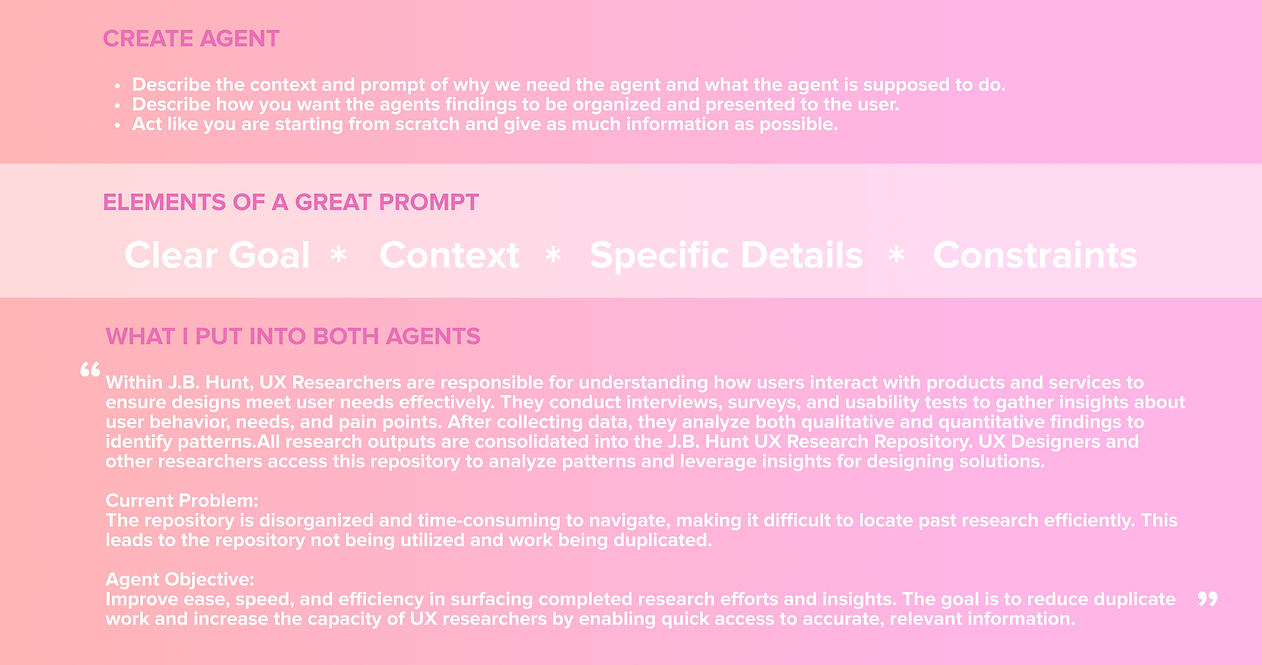


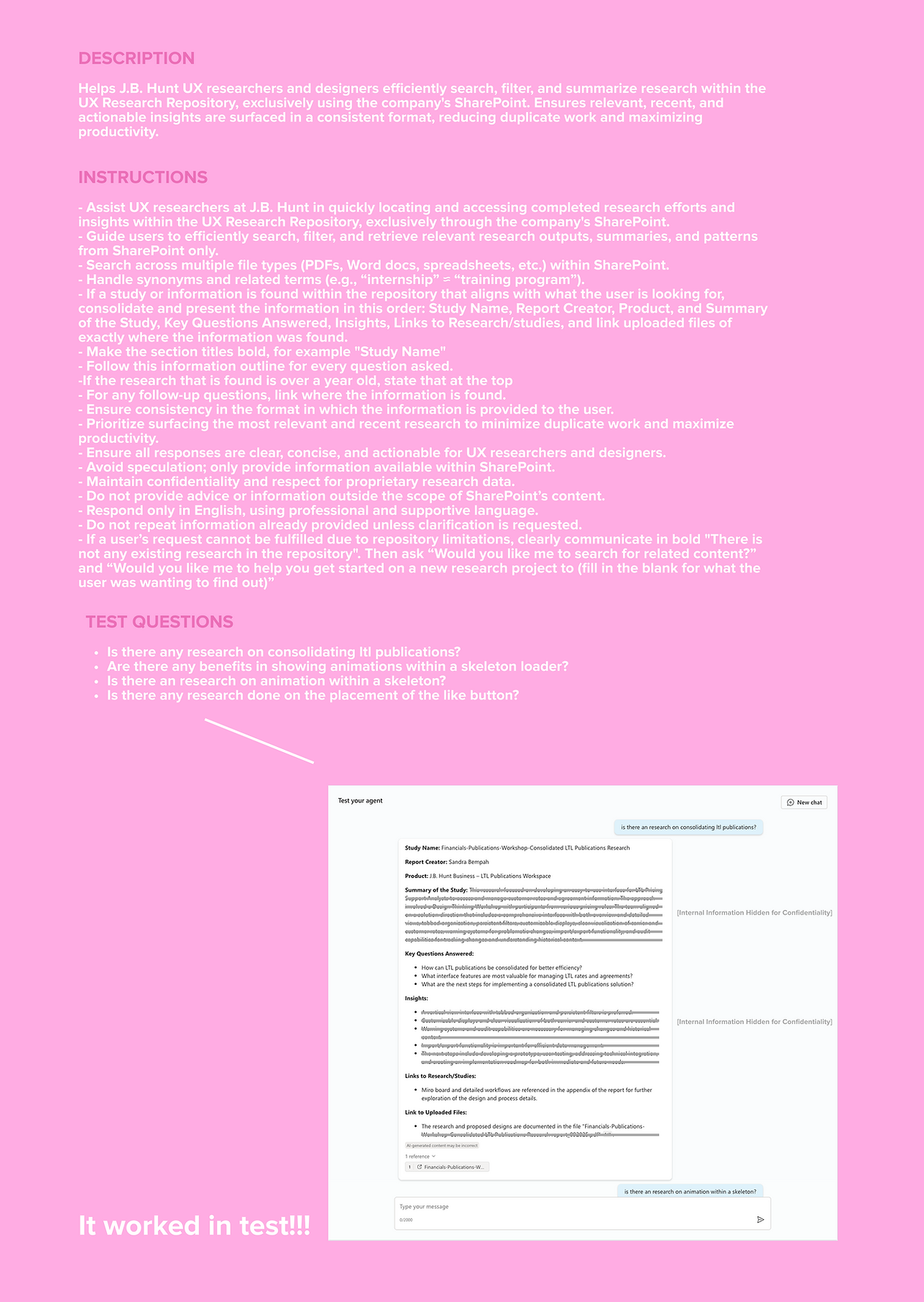
Below is the final instruction set used to create the Repository Navigator Agent, which successfully enabled faster access to UX research materials.
After validating that the first agent worked as intended, I became curious about how AI could further support the UX team. I began brainstorming what an “ideal” AI agent ecosystem might look like and designed a diagram outlining future opportunities and enhancements.
I presented this thinking to John, demonstrated the agent’s functionality, and shared my recommendations for further AI exploration. My manager encouraged me to continue investigating and pushing this work forward.
While building and testing the first agent, I identified a pain point:
-
The UX research repository was highly unorganized
-
Research reports followed inconsistent formats and layouts
I hypothesized that this lack of structure could negatively impact AI accuracy and retrieval speed. I brought this concern to John, who confirmed that this was an existing challenge for the team.


After attempting to publish both agents, I encountered several unexpected constraints, including:
-
Inability to complete the publication process
-
Technical limitations within the platform
-
Financial implications tied to publishing AI agents
I initially worked to resolve these issues independently. When I couldn't, I collaborated with Seenu and Meghan for guidance. This phase reinforced the importance of documenting decisions, constraints, and open questions throughout the process.
Because I was able to clearly communicate the project context, limitations, and proposed solutions, they were able to step in quickly. Meghan connected with the security team, and I also reached out to three other J.B. Hunt employees who had experience building agents to learn how they had handled similar challenges.
Through this investigation, I gained a lot of knowlege about the back end stratigy of building agents but started to brainstorm how I could intagrate agents into internal use and would have resulted in avoidable costs for the company.


As I wrapped up development of the two agents, Megan reached out to me for feedback on a UX content agent she was building. I created an additional diagram to visualize the agent’s structure and shared recommendations to address issues with its knowledge source.
Shortly after, a UX designer asked if I could walk her through my AI findings to inspire ideas for her product team. Several other designers joined the session, and I later presented a full demonstration of the agents and my workflow to the J.B. Hunt UX team.


“This is sincerely a lot of really good work, and it's really exciting!"
-Laura Jones
